
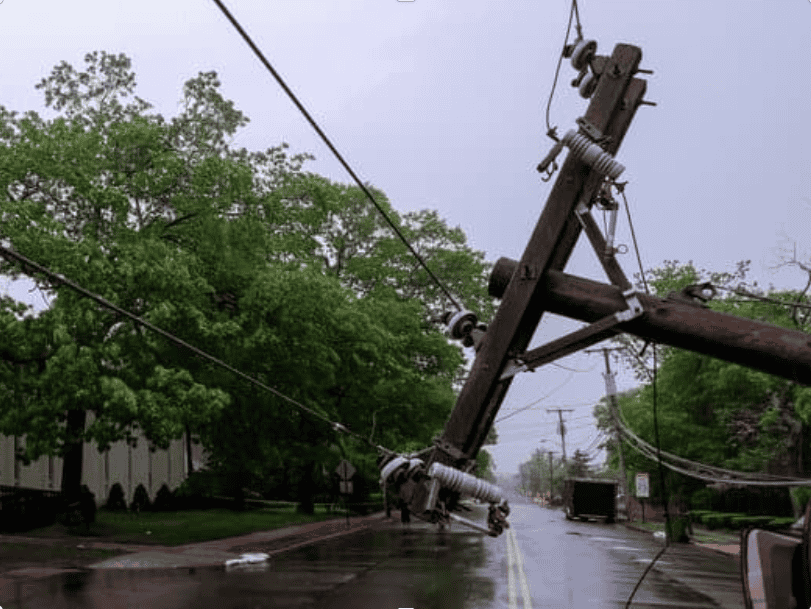
When a wood utility pole falls, the consequences escalate quickly. What begins as a single asset failure can turn into a public safety risk, a multi-network outage and a regulatory concern within minutes.
In most cases, collapse occurs after prolonged deterioration at the ground line. Severe weather, mechanical stress or sudden loading often trigger the final failure. However, once the pole is on the ground, the cause matters less than the response.
This article outlines what happens when a utility pole falls, from the initial safety response through to restoration, reporting and longer-term impact.
Immediate Consequences When a Utility Pole Falls
The first priority is always safety.
A fallen pole may leave conductors energised. The surrounding ground can also become live, particularly in wet conditions. As a result, the site presents an immediate danger to the public, road users, emergency responders, and wildlife.
Therefore, utilities treat every incident as live until proven otherwise.
Typical first actions include:
- Establishing a safe exclusion zone
- Isolating the affected circuit where possible
- Coordinating with emergency services
- Managing traffic and public access
At this stage, rapid control reduces risk. However, safety always comes before restoration.
Service Disruption and Network Impact
When a utility pole falls, service interruption follows immediately.
Electricity, telecoms and data services often share the same structure. Consequently, a single failure can disrupt multiple networks at once. In addition, sudden changes in line tension can place extra load on neighbouring poles.
Outage duration depends on several factors:
- Site accessibility
- Weather conditions
- Extent of damage
- Availability of crews and materials
For consumers, this means loss of power, communications and business continuity. For operators, it creates operational pressure and public visibility.
Repair and Replacement Following a Pole Collapse
Once crews secure the site, physical recovery begins. This stage usually involves:
- Removing the failed pole and debris
- Installing a replacement pole or structure
- Re-stringing or re-tensioning conductors
- Testing and controlled re-energisation
These works often happen under time pressure and outside standard hours. As a result, costs rise quickly. Labour, plant, traffic management and reinstatement all contribute to the overall impact.
Emergency replacement is significantly more expensive than planned intervention.
Reporting and Compliance After a Utility Pole Falls
Restoring supply does not close the incident. Depending on severity, utilities may need to:
- Notify regulators
- Complete statutory or internal reports
- Review inspection and maintenance records
- Investigate whether decay contributed to failure
- Respond to claims, complaints or enforcement action
If investigations identify ground-line decay, historic inspection data becomes central. At that point, attention often turns to the effectiveness of existing overhead line pole inspection and wood pole testing programmes.
Common Reasons Utility Poles Fall
Although triggers vary, most failures share similar characteristics. Common contributing factors include:
- Fungal decay at the ground line
- Long-term exposure to moisture and oxygen
- Increased wind loading during storms
- Mechanical damage from vehicles or plant
- Progressive loss of structural capacity
While these mechanisms are well understood, deterioration is not always visible above ground. Therefore, surface inspection alone does not always reveal the true condition of the pole.
Reducing Risk Before a Pole Falls
Understanding what happens when a utility pole falls highlights a broader issue. Failure response is costly, visible and disruptive. Risk reduction is far more effective.
Many operators now focus on identifying loss of strength before collapse occurs. Targeted assessment supports better decision-making and allows utilities to prioritise intervention where it matters most.
At EP Marine & Rail, our wood pole assessment method combines targeted ground-line drilling, precise shell-depth measurement, and precision software analysis to deliver an accurate, science-based understanding of each pole’s structural integrity. The result is a quantifiable RSV which shows if the pole is fit for service according to its original design, strength and factor of safety.
Because we measure the pole’s actual geometry and decay profile, not just surface condition or arbitrary shell thickness, our method provides a complete picture of pole health. Data is captured digitally and modelled in real time, producing auditable, repeatable, and objective results that stand up to engineering and regulatory scrutiny.
This approach not only improves accuracy and safety, but also extends life and reduces unnecessary replacement with up to 60% of S poles and 30% of D poles reclassified as serviceable. Minimal disruption, clear data, and proven reliability make our process the most effective and cost-efficient way to manage pole networks sustainably keeping CMLs and CIs to an absolute minimum.
Final Thoughts
When a wood utility pole falls, the impact extends well beyond the structure itself. Public safety risk, service disruption, regulatory scrutiny and cost follow close behind. Knowing what happens when a utility pole falls is essential. Acting early to reduce the likelihood of failure is what protects people, wildlife, infrastructure, and reputation.
Proactive understanding of wood pole condition remains a key part of resilient network management. Emergency replacement is expensive. Investigation takes time. Reputational recovery takes even longer.
Increasingly, utilities are looking at how earlier, more targeted assessment of wood pole condition can simplify decision-making, reduce reactive work and remove pressure before it escalates into an incident.
Exploring targeted assessment strategies now can make the difference between reactive firefighting and confident, planned management. We’re here and ready when you are.