
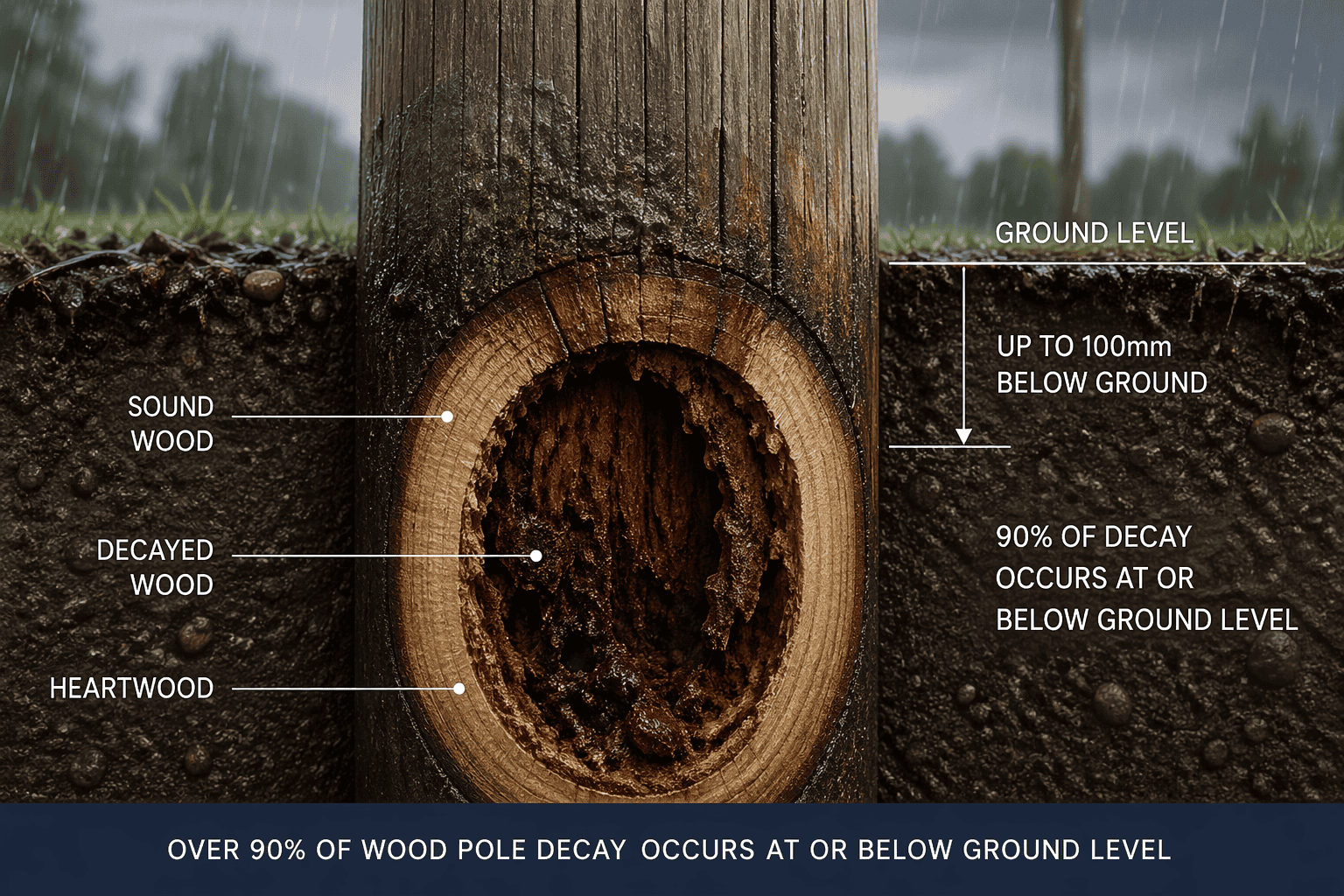
Across the UK, overhead line networks rely heavily on timber poles – many of which have been in service for decades. While these assets are inherently durable, their greatest point of vulnerability is also their least visible:
Decay at ground line.
Industry evidence consistently shows that over 90% of wood pole deterioration occurs at or just below ground level, typically within the first 100 mm beneath the surface. Yet despite this, many traditional inspection methods fail to assess this critical zone accurately – or at all.
For asset managers and overhead line engineers, this creates a persistent and costly dilemma:
- Replace too early → unnecessary capital expenditure
- Replace too late → increased risk of failure, safety issues, CMLs and CIs
Effective wood utility pole testing is therefore not just about inspection – it is about making defensible, data-driven decisions on safety, performance, and asset life.
The limitations of traditional pole inspection methods
Many widely used inspection techniques were not designed for large-scale, high-accuracy utility assessments. While they can provide surface-level insights, they often fall short where it matters most: ground-line integrity.
Resistograph / micro-drilling
Originally developed for arboriculture, this method uses a fine drill bit (typically around 3 mm) to detect resistance changes in timber.
- Follows the path of least resistance, reducing reliability in fissured or decayed wood
- High maintenance requirements and frequent bit breakage
- Inefficient at scale due to the volume of drilling required
Ultrasonic testing (PURL)
Uses transducers to detect internal voids via sound waves.
- Limited effectiveness unless testing is conducted below ground line
- Requires excavation to access the critical decay zone
- Results can be inconsistent, particularly in wet timber
Single-hole drilling
A larger diameter hole (typically 10 mm) drilled above ground level.
- Does not assess the ground-line zone
- Primarily used to determine suitability for reinforcement, not structural integrity
In practice, these methods either:
- fail to inspect the most critical area, or
- rely on indirect or inconsistent indicators of internal decay
From industry limitation to innovation: the development of PASS
Over more than 20 years working alongside UK DNOs, EP Marine & Rail has gained extensive experience using traditional testing systems, including resistograph drilling and ultrasonic methods.
While these techniques offer some value, their limitations – particularly in accurately assessing decay at ground line – highlighted the need for a more reliable and consistent approach.
This led to the development of the PASS (Pole Analysis & Structural Security) system.
PASS was specifically designed to:
- directly assess the critical ground-line zone where the majority of decay occurs
- eliminate reliance on prediction, indirect readings, or inconsistent data
- provide repeatable, engineering-grade measurements for confident decision-making
Rather than estimating internal condition, PASS enables inspectors to physically measure both external and internal decay above and below ground line, delivering a far more accurate representation of pole integrity.
How ground-line testing works in practice
At the core of EP Marine & Rail’s approach is the PASS methodology, engineered for accuracy, repeatability, and operational efficiency.
The process involves:
- Drilling three 10 mm diameter holes, equally spaced around the pole at ground line
- Angling each hole at 45° to target the zone approximately 100 mm below ground level
- Using a Shell Depth Indicator to measure:
- remaining sound wood
- internal decay or voids
Each pole is also visually assessed for:
- external damage
- decay pockets
- biological activity (e.g. woodpecker damage)
- pole-top deterioration
This combination of targeted measurement and structured visual assessment ensures that the most critical structural zone is properly evaluated.
From measurement to engineering decision: RSV
Data collection alone is not enough. The real value lies in how that data is applied.
All measurements are combined with key design and loading parameters, including:
- conductor type
- span length
- line deviation or angle
- stay configuration
- network loading conditions
This information is processed using specialist software to calculate the Residual Strength Value (RSV) of each pole.
This enables engineers to determine:
- whether the pole remains fit for purpose
- how it performs against original design safety factors
- its remaining service life
This transforms wood utility pole testing from a subjective inspection process into a quantitative engineering assessment.
Proven impact: extending asset life and reducing unnecessary replacement
Accurate ground-line testing has a direct and measurable impact on asset management strategy.
In one of our assessment programmes:
- 367 poles were identified as “suspect” following visual and hammer testing
- PASS assessment determined that:
- 79% were fit for purpose with ≥10 years’ service life
- 6% were suitable for reinforcement
- 85% of poles were returned to service
This resulted in substantial cost savings while maintaining required safety margins.
Across broader programmes, this approach has consistently demonstrated:
- up to 60% of S poles retained
- up to 30% of D poles retained
- reduced unnecessary replacements and associated disruption
- minimised CMLs and CIs
Addressing a common concern: does drilling weaken the pole?
A common concern with ground-line drilling is its potential impact on structural strength.
Extensive international research – including large-scale deployment in North America, where over 200 million poles are routinely assessed – shows that:
- strength reduction is typically only 2-3%, depending on pole size
- this reduction is negligible when compared to the benefit of accurate condition assessment
In addition, the same drill holes can be used for:
- boron-based rot prevention treatments
- future inspections, improving long-term monitoring efficiency
Why this matters for DNOs and asset managers
For those responsible for overhead line networks, the benefits of accurate wood utility pole testing are clear:
- Improved capital efficiency: Avoid unnecessary replacement of structurally sound assets
- Enhanced network reliability: Identify and address genuine risk before failure occurs
- Regulatory confidence: Maintain auditable, data-driven inspection records
- Extended asset life: Combine testing with targeted treatment and reinforcement
- Reduced operational disruption: Minimise outages and avoid unnecessary interventions
In the context of ageing infrastructure, increasing demand, and regulatory scrutiny, these outcomes are operationally significant.
A more scientific standard for wood utility pole testing
The industry is moving away from subjective inspection techniques toward measurable, repeatable, and auditable assessment methods.
As the developer of PASS, EP Marine & Rail has been at the forefront of this shift – helping DNOs transition from assumption-based inspection to data-driven asset management.
By focusing on the ground-line zone, directly measuring decay, and applying engineering analysis through RSV modelling, this approach provides:
- clarity instead of assumption
- data instead of estimation
- confidence instead of uncertainty
Testing beyond standard conditions: adapting to complex environments
It’s worth mentioning that while most overhead line assets are located in standard terrestrial environments, not all poles present straightforward access conditions.
In certain cases, infrastructure extends into more challenging environments such as waterlogged ground or fully submerged installations where conventional ground-line inspection methods are not viable.
In such cases, alternative assessment techniques such as seismic testing methodologies are used to evaluate structural integrity without relying on conventional drilling approaches.
The principle remains consistent:
select the most appropriate non-destructive testing method for the environment in order to determine true structural condition.
Supporting your network assets
If you are responsible for overhead line assets and are looking for a more accurate and cost-effective approach to wood utility pole testing, EP Marine & Rail can help.
With over 20 years of experience supporting UK DNOs, we provide:
- objective, data-driven assessments
- clear recommendations for repair, reinforcement, or replacement
- practical strategies to extend asset life and reduce unnecessary cost
We would be happy to discuss how we can support the assessment and management of your overhead line assets, helping to improve network resilience today and ensure long-term operational certainty.