
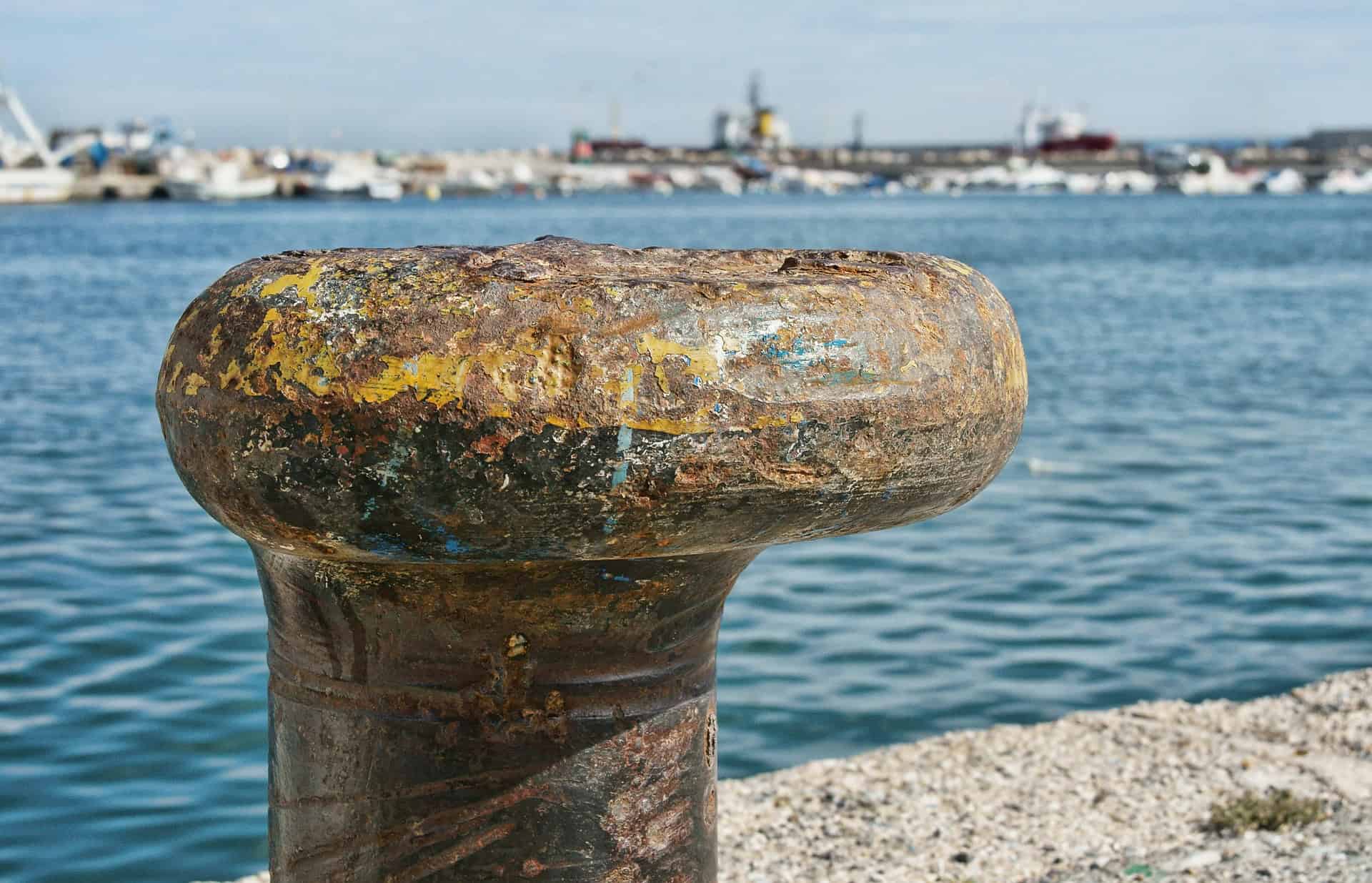
Across UK ports and harbours, marine bollards play a critical but often under-evaluated role in daily operations. They form the essential interface between vessel and shore. And as a result, they absorb complex and highly variable forces during mooring and towing operations.
However, in many locations, the Safe Working Load assigned to mooring bollards is not based on fully verified or up-to-date data. Instead, it may rely on legacy design assumptions, incomplete records, or limited historical testing.
As vessel sizes continue to increase, the need for accurate, evidence-based assessment has become more important than ever.
What SWL Means in Marine Bollard Systems
Safe Working Load (SWL) defines the maximum load that a bollard can safely withstand under normal operating conditions. For SWL of marine bollards, this value should reflect the combined performance of several critical elements:
- The bollard itself
- Fixings and anchor systems
- The surrounding quay or supporting structure
- Long-term material condition and degradation
In practice, the SWL is only as reliable as the data used to define it. Therefore, uncertainty in any one of these areas affects overall confidence in the rating.
Why SWL Data Is Often Uncertain in Older Ports and Harbours
Many UK ports and harbours operate infrastructure that has developed over decades. Consequently, SWL information can be incomplete or inconsistent.
In these environments we’ve seen that data for SWL of marine bollards may be:
- Missing from original design records
- Based on outdated engineering assumptions
- Assigned without modern verification methods
- Affected by undocumented structural modifications
Even where SWL markings exist, they may no longer reflect the true condition or capacity of the asset. As a result, a gap often exists between assumed performance and actual structural integrity.
How Load Demands Have Changed Over Time
The operational environment around SWL of marine bollards has changed significantly. Modern vessels and tug operations now introduce higher and more dynamic loading conditions than those originally anticipated.
Key drivers include:
- Larger cruise and commercial vessels
- Increased windage and displacement forces
- More frequent extreme weather and surge events
Because of these factors, many marine bollards now operate closer to their real limits than historical design documents suggest.
SWL Of Marine Bollards Testing: Current Industry Approaches
To manage uncertainty, the industry uses several testing methods.
Traditional Load (Pull) Testing
Historically, engineers have tested bollards by applying load through vessels or mechanical pulling systems. This method can confirm capacity. However, it also has limitations.
It introduces high stress into ageing infrastructure. In addition, it provides limited insight beyond pass or fail outcomes. It also does not reveal subsurface condition or hidden degradation.
In some documented cases, load testing has led to visible movement or outright failure of marine bollards, particularly where degradation already existed below the surface. Anyone who has witnessed a pull test go wrong will understand the scale of energy involved – in extreme cases, bollards have been forcibly dislodged under load.
For this reason, pull testing carries an inherent level of risk, both to the asset and to the surrounding environment.
Mechanical Load Simulation Systems
More recent systems use hydraulic or crane-based rigs to apply controlled force directly to the bollard. These systems often operate within reinforced or blast-rated containment structures designed to manage the consequences of a sudden failure.
That level of protection is telling.
If a test requires containment designed to withstand a violent release of energy, it highlights the potential severity of failure under load – regardless of how controlled the test conditions may appear.
While this approach reduces reliance on pull vessels, the principle remains unchanged: force is applied to prove capacity.
However, applying high loads to ageing marine bollards can still:
- Trigger hidden weaknesses
- Cause internal or foundation-level movement
- Introduce or accelerate damage that may not be immediately visible
So, while the test may be controlled, the response of the asset is not always predictable.
The Challenge with Load-Based Testing
The core issue is not whether load testing works in principle. It is what it actually measures. Load-based methods assess performance under a moment of extreme stress, rather than providing insight into the condition of the asset over time.
When testing the SWL of marine bollards, this raises a critical question:
If a bollard passes a load test, has its condition improved – or has it simply survived a single high-stress event?
A Different Approach: Non-Destructive Testing (NDT)
At EP Marine and Rail, we take a different approach. Rather than applying load, we focus on understanding the structure itself. Our non-destructive testing methods assess SWL of marine bollards using techniques such as:
- Ground Penetrating Radar (GPR) to assess subsurface conditions
- Eddy current testing to identify surface and near-surface defects
- Ultrasonic methods to evaluate internal integrity, including both the surrounding structure and the individual bolts that secure the bollard in place
This combined approach is important. In many cases, the critical point of failure is not the bollard itself, but the condition of its fixings or the integrity of the structure beneath and around it.
As a result, we build a detailed, evidence-based picture of the entire load path – not just the visible asset – without introducing mechanical stress.
Why This Matters for Ports and Harbour Authorities
For marine directors and harbour masters, the value is not only technical. It is operational.
NDT provides:
- Clear, evidence-based understanding of the real SWL of marine bollards
- Auditable data to support SWL assignment or reassessment
- Reduced risk of introducing damage during inspection
- Insight where original SWL data is missing or uncertain
In many cases, this allows harbours and ports to move from assumption-led management to data-driven decision-making.
From Testing to Understanding
The goal of assessing SWL of marine bollards should not be limited to proving they can withstand a single load event. Instead, the goal should be to understand how they perform within the wider structure and how that performance may change over time.
This distinction matters. Therefore, infrastructure decisions must consider safety, operations, and financial risk together.
EP Marine and Rail: Supporting Smarter Infrastructure Decisions
EP Marine and Rail is a specialist team focused on delivering practical inspection solutions for marine infrastructure.
Our approach is built on three principles:
- Accuracy without disruption
- Evidence over assumption
- Clarity over complexity
We work closely with ports, harbours, and asset managers to simplify complex infrastructure challenges. By combining advanced, non-destructive testing with clear reporting, we help clients understand the true condition and capacity of the SWL of marine bollards – without introducing risk to the asset.
One of the key advantages of this approach is the quality of insight delivered without unnecessary operational disruption or overly conservative assumptions.
In many cases, assessments show that marine bollards are in better structural condition than expected, particularly where visual appearance suggests greater deterioration than is actually present internally.
Where concerns are identified, this methodology also supports controlled, evidence-based downrating, allowing assets to remain safely in service with appropriate, defensible load ratings rather than being removed or restricted unnecessarily.
To support confidence in our process, we can also provide a sample inspection report on request. This allows stakeholders to review the level of technical detail, clarity, and traceability included in our assessments before any commitment is made.
Ultimately, this approach enables ports and harbour authorities to make more informed infrastructure decisions. It helps balance safety, operational continuity, and whole-life cost management using clear, verifiable data rather than assumption.
Conclusion
As marine operations continue to evolve, the demands placed on port and harbour infrastructure will continue to increase. For SWL of marine bollards, this means one thing: historical assumptions are no longer sufficient.
Modern asset management requires methods that reflect current conditions, not just original design intent.
By shifting from load-based testing to non-destructive assessment, ports can achieve a more accurate and defensible understanding of their infrastructure.
As a result, they gain better decisions, improved safety, and greater operational confidence.