
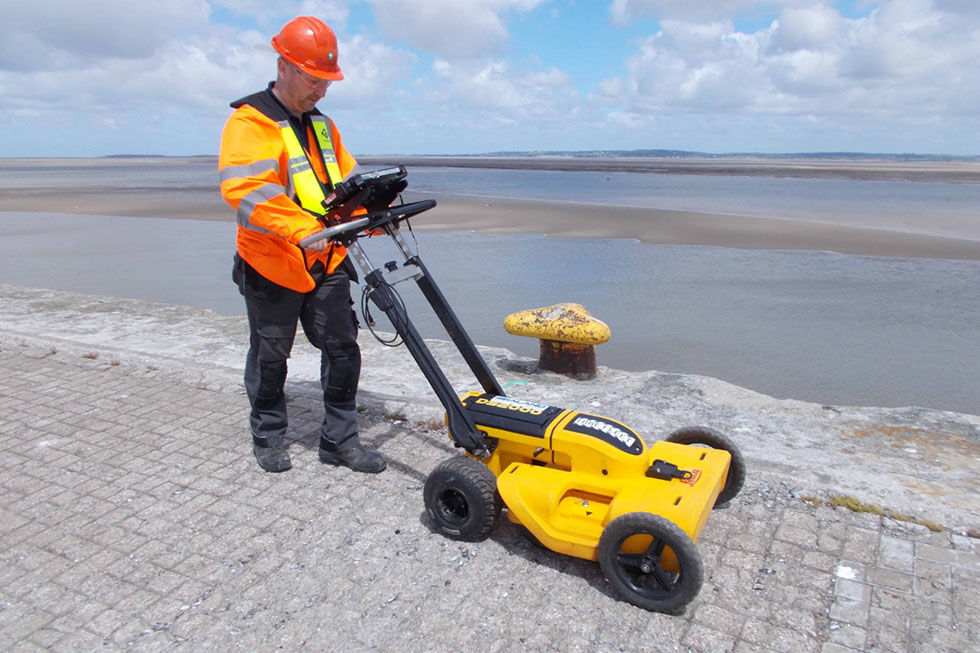
Hidden structural risks threaten ports and harbours. Consequently, engineers rely on ground penetrating radar (GPR) to assess marine infrastructure, especially when excavation or intrusive inspection is impractical or unsafe.
GPR transmits short pulses of high‑frequency electromagnetic energy into the ground or structure beneath the surface. Then, when signals hit materials with different densities, moisture levels, reinforcement, or voids, part of the signal reflects back. Engineers analyse these reflections to map what lies beneath the surface.
In addition, GPR lets engineers assess mooring bollards, deck slabs, quay structures, and harbour walls. It detects washouts and voids. It tracks how loads move through the surrounding structure – all without disrupting operations.
Unlike pull testing, which gives a single load value, GPR delivers a full structural map. Moreover, it shows why a bollard underperforms rather than just whether it passes.
What GPR Reveals What the Eye Cannot
One of the most valuable aspects of ground penetrating radar is that it identifies deterioration long before it becomes visible. For example, at EP Marine & Rail, our engineers often inspect harbour walls and mooring infrastructure that appear outwardly sound. Decks may look intact and bollards may show no movement. Furthermore, no cracking or settlement appears on the surface.
However, GPR surveys reveal a very different reality beneath the surface.
We often find large washout zones behind harbour walls and under deck slabs. These voids occur where supporting materials erode over time. Visual inspections cannot detect them. In some cases, structures span empty space, relying on reinforcement not designed for that load.
Hidden deterioration presents serious risk. Once movement or cracking appears, damage is already advanced. Meanwhile, it limits repair options and operational disruption increases.
Why Washouts Occur in Marine Structures
Washouts are a common but frequently underestimated issue in ports and harbours. They occur when fine material is gradually removed from behind or beneath a structure, leaving voids that compromise load transfer and stability.
Typical causes include:
- Tidal pumping: Tidal flows push and pull through joints and cracks, carrying material away.
- Wave action and propeller wash: Vessel movements and thruster activity can mobilise sediments and increase hydraulic pressures around quay walls.
- Ageing drainage systems: Blocked or failed drains allow water to accumulate, increasing hydrostatic pressure and accelerating material loss.
- Historic construction methods: Older structures often relied on mass concrete, rubble fill, or materials that were never designed for modern load demands or prolonged exposure to today’s operating conditions.
Over time, these processes create extensive voids before any surface signs appear. Ground penetrating radar is particularly effective at detecting these zones early, before they translate into visible damage or structural failure.
Why Ground Penetrating Radar Matters for Bollard Integrity
Many in‑service bollards were installed decades ago, long before current vessel sizes, line loads, and operational practices became the norm. While the bollard itself may appear robust, its performance depends entirely on the condition of the surrounding concrete, sub‑base, and anchorage zone.
Integrating ground penetrating radar into bollard integrity programmes allows harbours, ports and operators to:
- Visualise subsurface conditions around and beneath bollard foundations, often several metres horizontally and vertically depending on ground conditions.
- Identify voids, washouts, and poor consolidation that reduce effective load transfer.
- Assess foundation extent and construction type, particularly where drawings or records are incomplete or unreliable.
- Support evidence‑based SWL decisions, replacing assumption with measured data.
- Carry out testing with zero operational disruption, keeping berths live during assessment.
Our engineers often interpret field data on-site, flag anomalies, and recommend next steps immediately.
Why GPR Alone Is Not Enough
Ground penetrating radar provides vital insight, but it does not tell the whole story alone. At EP Marine & Rail, GPR is rarely used in isolation.
To fully assess mooring infrastructure integrity, we combine GPR with complementary non‑destructive testing (NDT) techniques:
- Eddy current testing assesses metallic components, identifying corrosion, cracking, and section loss in bolts, studs, and fixings that may not be visible at the surface.
- Ultrasonic testing verifies bolt length, anchorage depth, material condition, and the integrity of baseplates and embedded elements.
- Ground penetrating radar focuses on the surrounding structure and foundation medium – revealing voids, washouts, reinforcement layout, and changes in material condition.
Each method answers a different question. Together, they provide a coherent and reliable picture of how the bollard, its fixings, and its foundation behave as a single system. As a result, this integrated approach significantly reduces uncertainty and avoids the false reassurance that can arise from relying on a single test method.
Operational and Lifecycle Benefits
Integrating ground penetrating radar into a wider NDT strategy delivers clear benefits across the asset lifecycle:
- Early intervention: Detects subsurface deterioration before it leads to movement, cracking, or failure.
- Targeted repairs: Focus remedial works where they are genuinely needed, avoiding unnecessary replacement.
- Improved risk management: Supports compliance with mooring safety standards, insurer expectations, and duty‑of‑care obligations.
- Traceable evidence: Provides digital outputs as a defensible audit trail for asset management and long‑term planning.
In Summary
Ground penetrating radar brings clarity to areas of marine infrastructure that have historically been governed by assumption. By revealing what lies beneath the surface, it allows ports and operators to make informed decisions about safety, maintenance, and investment.
At EP Marine & Rail, we integrate GPR with eddy current and ultrasonic inspection. Consequently, we gain a complete view of mooring infrastructure, supporting safer operations and extending asset life.
If you’d like to understand what’s really happening beneath your infrastructure, have a chat with our team about how ground penetrating radar and integrated NDT can support your assessments.