
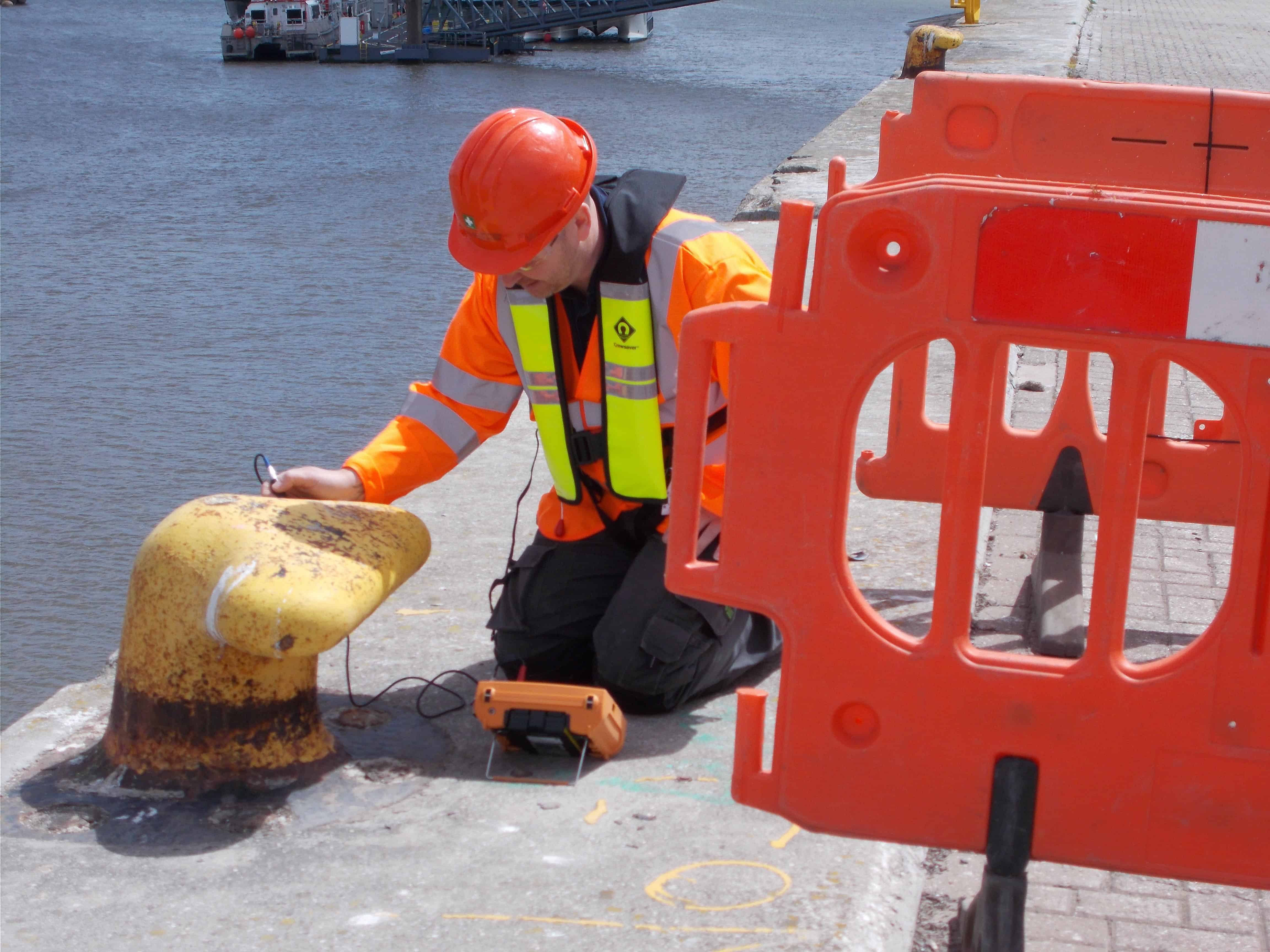
We’ve just come off a recent inspection where a clear case of marine bollard failure developed in a way that, externally, looked relatively unremarkable. However, once we started working back through the structure, it became clear this wasn’t a sudden event.
Instead, this was a progressive bollard failure mechanism that had been developing within the anchorage system for some time.
And importantly, it reinforces something we see repeatedly in cruise port infrastructure and heavy-duty berthing assets: by the time bollard failure becomes visible, the structural degradation is already well advanced beneath the surface.
So, let’s break it down properly.
Marine bollard failure is rarely a surface-level problem
In most marine environments, bollard failure doesn’t originate in the visible casting or exposed steelwork. Instead, it begins within the load transfer system beneath the base plate.
This typically includes:
- anchor bolts
- grout beds
- steel-concrete interfaces
- reinforced concrete foundations
As a result, bollard failure is fundamentally a subsurface structural process rather than a surface defect.
And that distinction is critical for how we interpret risk in port and harbour asset management.
Initiation phase: chloride ingress and electrochemical corrosion
In the case we recently assessed, the initiating mechanism behind bollard failure was chloride-induced corrosion.
This is one of the most common drivers of long-term bollard failure in marine infrastructure.
How chloride ingress actually works
Chloride ions from seawater penetrate concrete through:
- diffusion through pore water
- capillary suction in partially saturated concrete
- microcracks formed under cyclic loading
- splash zone and tidal exposure cycles
Over time, chlorides migrate through the concrete matrix until they reach embedded steel elements such as anchor bolts. It means that negatively charged chloride ions move naturally from areas with high salt concentrations (seawater) to areas with low concentrations (the inside of the concrete) by slowly drifting through the moisture trapped inside the structure’s microscopic pores.
Once a critical chloride threshold is reached at the steel surface, the passive oxide layer that protects steel in alkaline concrete breaks down.
At that point, the electrochemical system changes fundamentally:
- steel becomes anodic in localised areas
- oxygen reduction occurs at cathodic zones
- corrosion cells are established
- iron oxidises into expansive corrosion products (rust)
This electrochemical reaction is one of the earliest drivers of marine bollard failure, even though it is completely hidden from view.
Progression phase: loss of anchorage integrity
As corrosion develops, the structural behaviour of the bollard system begins to change.
We typically see:
- reduction in anchor bolt cross-sectional area
- breakdown of steel-grout bond strength
- localised cracking in surrounding concrete
- uneven load distribution across remaining anchors
At this stage, the bollard may still appear operational. However, internally, the system is already transitioning into a degraded load path condition.
This is where marine bollard failure becomes a system-level issue rather than a component-level defect. And, importantly, load is redistributed into fewer remaining effective anchors, increasing stress concentrations and accelerating deterioration.
Failure phase: structural collapse of the load transfer system
Eventually, the system reaches a point where it can no longer redistribute load effectively.
In the recent case, bollard failure occurred through a combination of:
- anchor bolt fracture
- partial pull-out of the anchorage system
- base plate rotation under service load
From an engineering perspective, the critical moment is not the fracture itself, but the loss of redundancy in the load transfer system. This means that once redundancy is lost, bollard failure becomes non-linear and rapid.
Typical final failure modes include:
- sudden anchorage failure
- uplift or rotation of the base plate
- shear failure through remaining fixings or grout interface
And by this stage, the failure process has already been active for an extended period.
Why chloride-induced bollard failure is so persistent in ports and harbours
One of the key reasons marine bollard failure is so prevalent in maritime infrastructure is that chloride exposure is continuous and cumulative.
Unlike isolated mechanical damage, chloride ingress is driven by ongoing environmental exposure:
- tidal wetting and drying cycles
- airborne salt deposition
- splash zone saturation
- capillary absorption through microcracks
Once chlorides reach steel depth, corrosion becomes self-sustaining which is why bollard failure is best understood as a time-dependent electrochemical process rather than a purely mechanical one.
Why visual inspection alone is not enough
In the case we reviewed, external signs of bollard failure were minimal – and this is a really common challenge in port infrastructure.
Visual inspection can identify:
- surface corrosion
- cracking or spalling
- visible deformation
- obvious structural damage
However, it cannot detect:
- subsurface corrosion of anchor bolts
- grout voiding or debonding
- internal fatigue cracking
- loss of load transfer capacity
This is why advanced inspection methods are essential in understanding true bollard failure risk, including:
- ultrasonic testing (UT)
- electromagnetic corrosion assessment
- ground penetrating radar (GPR)
These techniques allow us to assess subsurface failure risks that visual inspection alone will not capture.
Engineering takeaway: bollard failure is a system failure
What this recent case reinforced is straightforward but important: marine bollard failure is a progressive system breakdown.
It begins with chloride-driven electrochemical corrosion, progresses into structural load redistribution, and ultimately results in loss of anchorage integrity.
Understanding this sequence is critical for:
- bollard SWL reassessment
- cruise port infrastructure management
- harbour wall safety evaluation
- long-term asset management strategies
Final thoughts
Every case of marine bollard failure has a clear underlying mechanism when viewed through the correct engineering lens.
What appears sudden at the surface is almost always the final stage of a long, hidden degradation process.
And the more clearly we understand that process, the better we can manage risk, extend asset life, and ensure the safety of critical port infrastructure.