
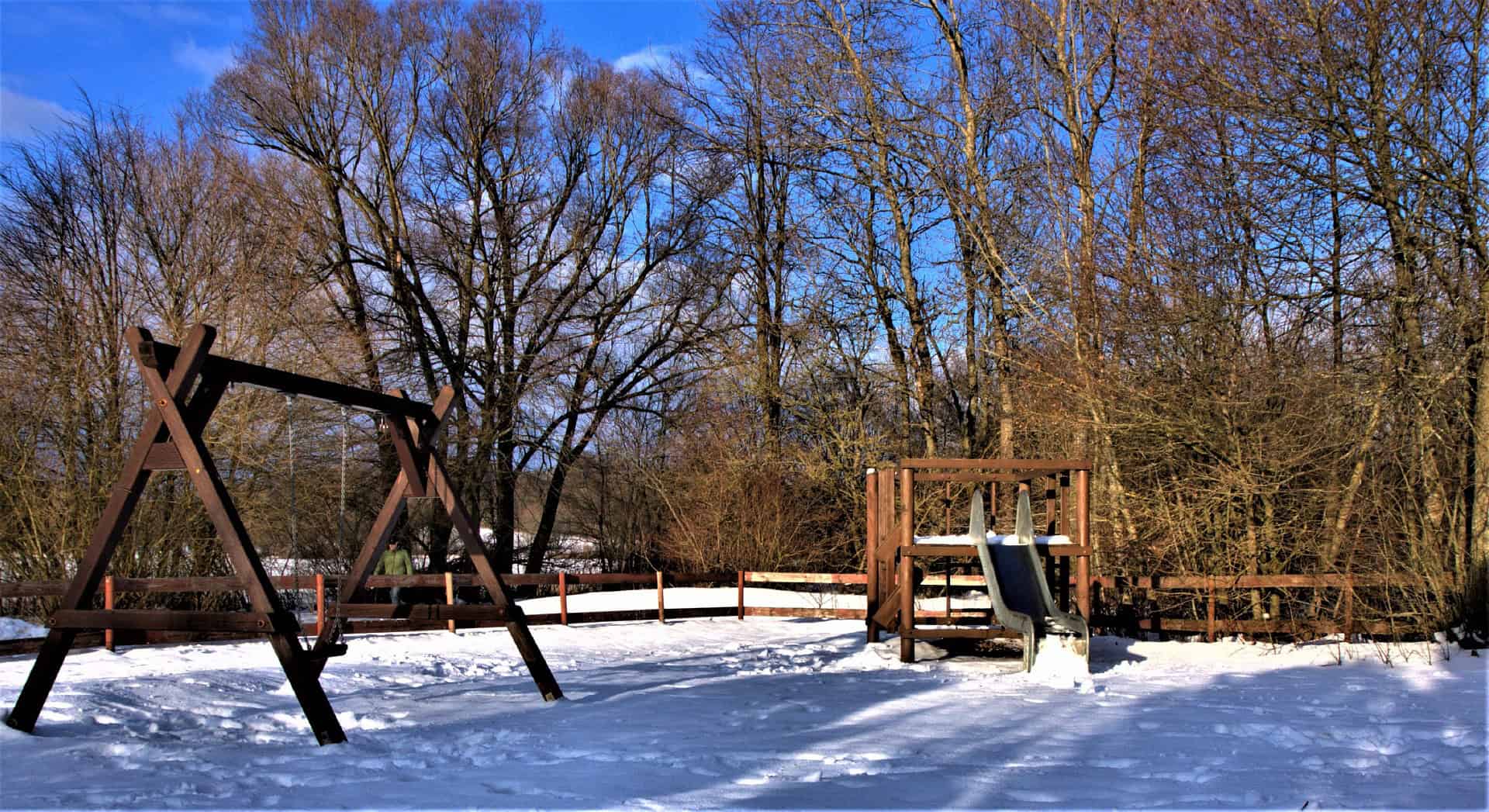
There is something rather special about a community playground. The slide worn smooth over the years, with the occasional dent or bend in it. The climbing frame with paint chipping off it, and bare patches on the playing field where too many feet have trodden.
It might not be the biggest or newest playground in the area. Perhaps it has been there for twenty years, tucked away beside the village hall, recreation ground or playing field. It might have a set of swings, a climbing frame, a slide and a few sturdy timber structures that generations of local children have grown up using.
For the children, it is simply somewhere to play.
For the parish council responsible for it, however, there can be a lot more to consider.
There are safety responsibilities, routine inspections, maintenance, insurance, budgets and, increasingly, questions about whether ageing equipment can continue to provide safe play without requiring expensive replacement.
Then someone raises a potential problem with a timber support.
Perhaps there is visible decay. It might be that the timber has deteriorated around ground level. Maybe an inspection has raised a concern that needs further investigation.
And suddenly, a playground that children have been happily using for years may be closed while someone tries to establish what condition the timber is actually in.
That is a difficult position for any council to find itself in.
When the safest decision is to stop and ask questions
When children are using a structure and there is uncertainty about the condition of a load-bearing timber, safety has to come first.
But it raises another question:
What happens when nobody actually knows whether the timber needs replacing?
A parish council may have a limited maintenance budget. Parents may be asking when the playground will reopen. Councillors may be receiving questions from residents. Meanwhile, nobody has enough information about the timber to make a confident decision.
Replace the structure?
Spend money investigating it?
Keep it closed while waiting for a decision?
Or hope that the timber is sound?
None of those choices feels particularly comfortable.
There is, however, another option.
Find out what condition the timber is actually in.
The importance of keeping community playgrounds available
This matters because playgrounds give children somewhere to run, climb, swing, explore and meet other children. For many families, particularly those who do not have large gardens or easy access to other recreational facilities, the local playground is an important part of everyday life.
We are also seeing a wider conversation about the importance of giving children opportunities to play outdoors.
Play England has been calling for a renewed national approach to play, while local authorities and communities continue to face the practical challenge of maintaining the play spaces they already have.
That means the conversation cannot simply be about creating new playgrounds.
We also need to think about how we maintain the ones that communities already rely upon.
And that brings us back to the timber.
What if the timber is better than it looks?
Timber has an extraordinary ability to withstand the British weather.
A substantial timber support can stand outdoors for decades through rain, frost, wind, heat and repeated cycles of wetting and drying.
However, its external appearance does not necessarily tell the whole story.
Decay can develop internally, particularly around the ground-line zone, while other problems can develop elsewhere along the pole. We look for deterioration throughout the timber, including ground-line decay, top rot, bird damage, splits, damage and other factors that may affect structural integrity.
Equally, timber that looks old, weathered or tired may still contain considerably more sound wood and structural capacity than someone looking at it from the outside might expect.
That is why playground timber inspection can provide such useful information when a visual inspection has raised a question but cannot answer it.
A visual inspection tells you that something warrants attention.
A specialist assessment can help establish what is actually happening within the timber.
We don’t arrive looking for a reason to replace it
This is probably one of the most important things I would want a parish council to understand about the way we work.
We don’t arrive assuming that an old timber support needs to be replaced.
Equally, we don’t arrive assuming that it is perfectly sound because it has stood there for twenty years.
We assess it.
Our experience comes from more than two decades of assessing timber utility poles for the UK electricity distribution industry. During that time, we have assessed many thousands of timber poles and developed a detailed understanding of how deterioration affects structural capacity.
We look at the timber as a whole, including the areas where decay is most likely to affect structural performance. We capture measurements digitally and use specialist software to calculate residual strength and assess fitness for purpose against the requirements of the structure.
That gives the asset owner something considerably more useful than being told that a timber pole is “old”, “weathered” or “showing signs of decay”.
It provides clear, data-driven evidence.
And sometimes the answer is surprisingly reassuring
There is something particularly satisfying about arriving to assess a timber structure that everyone is worried about and discovering that it is in considerably better condition than anticipated.
I think there is a very human reason for this.
When something involves the safety of children, our minds naturally look towards what could go wrong.
If a timber support has been standing for decades, it is easy to look at the age of the structure and start wondering how much life it has left.
That caution is important. We should never take unnecessary risks with structures used by children.
But uncertainty can sometimes make a problem feel larger than it actually is.
We have assessed poles that initially caused concern and found considerably more sound timber and structural capacity than expected.
Of course, that isn’t always the result.
Sometimes deterioration has progressed too far. At times reinforcement or remedial treatment makes sense. And sometimes we find that the timber is in considerably better condition than previously thought.
Our job is not to produce a particular answer. Our job is to establish what is actually there.
For a parish council, that distinction can be extremely valuable.
A better answer can mean a better use of a limited budget
Local and parish councils rarely have unlimited funds sitting in a pot waiting for the next playground problem.
Every expenditure has to be considered alongside other demands on the community.
If the assessment shows that a timber structure retains sufficient structural capacity, replacing it unnecessarily may divert money away from other improvements or maintenance.
When it requires reinforcement, knowing that early may allow the council to plan the work rather than dealing with a more urgent failure later.
If replacement really is necessary, having a clear assessment can help the council understand why that expenditure is required and plan accordingly.
In each case, better information supports a better decision.
That is particularly important when residents are asking a very simple question:
“When is the playground going to reopen?”
The council is trying to do the right thing too
Councils sometimes get a rather unfair press when playgrounds close.
The people responsible for these facilities are often trying to balance several competing priorities at once.
They need to protect children while listening to parents and residents. Tight budgets mean that investment needs to be well spent.
And when something unexpected appears in an inspection report, they need to decide what to do next.
That isn’t always straightforward.
A specialist timber assessment gives them another piece of evidence to work with.
It doesn’t replace the council’s existing inspection regime, risk assessment or professional responsibilities. Instead, it can sit alongside those processes and answer a more specific question:
What condition is the timber itself in?
From uncertainty to evidence
This is why there is a place for specialist playground timber inspection alongside the established inspection and maintenance arrangements already used by councils and playground operators.
We aren’t trying to replace those services.
That could be a parish council playground where an inspection has identified possible decay.
It could be a local community recreation ground with ageing timber structures.
It could be a playground that has been closed because the condition of its supporting timbers is unknown.
Or it could simply be a council that wants to understand the condition of its timber assets before deciding where to spend its maintenance budget.
The child is still waiting at the gate
Somewhere, there is a child who doesn’t know anything about residual strength, timber decay, inspection regimes or maintenance budgets.
They simply know that the playground where they used to hang out with their friends is closed.
They want to swing, climb, run around, let off steam – do what children are supposed to do: have fun outdoors.
And the people responsible for that playground want exactly the same thing for them, provided they can be confident that it is safe to do so.
That is where engineering has a very practical role to play.
Sometimes, before a council can decide whether to repair, reinforce, replace or reopen, it needs better information.
A playground timber inspection can help provide that information.
At EP Marine & Rail, we bring more than two decades of timber pole assessment experience from the electricity distribution industry to this area of recreational timber assessment.
We are happy to have an open conversation about what you have, what concerns have been raised and what information you need before making your next decision.
Because keeping children safe matters.
Keeping community facilities available matters too.
And sometimes the most useful thing you can do before replacing a timber structure is simply find out what condition it is actually in.