
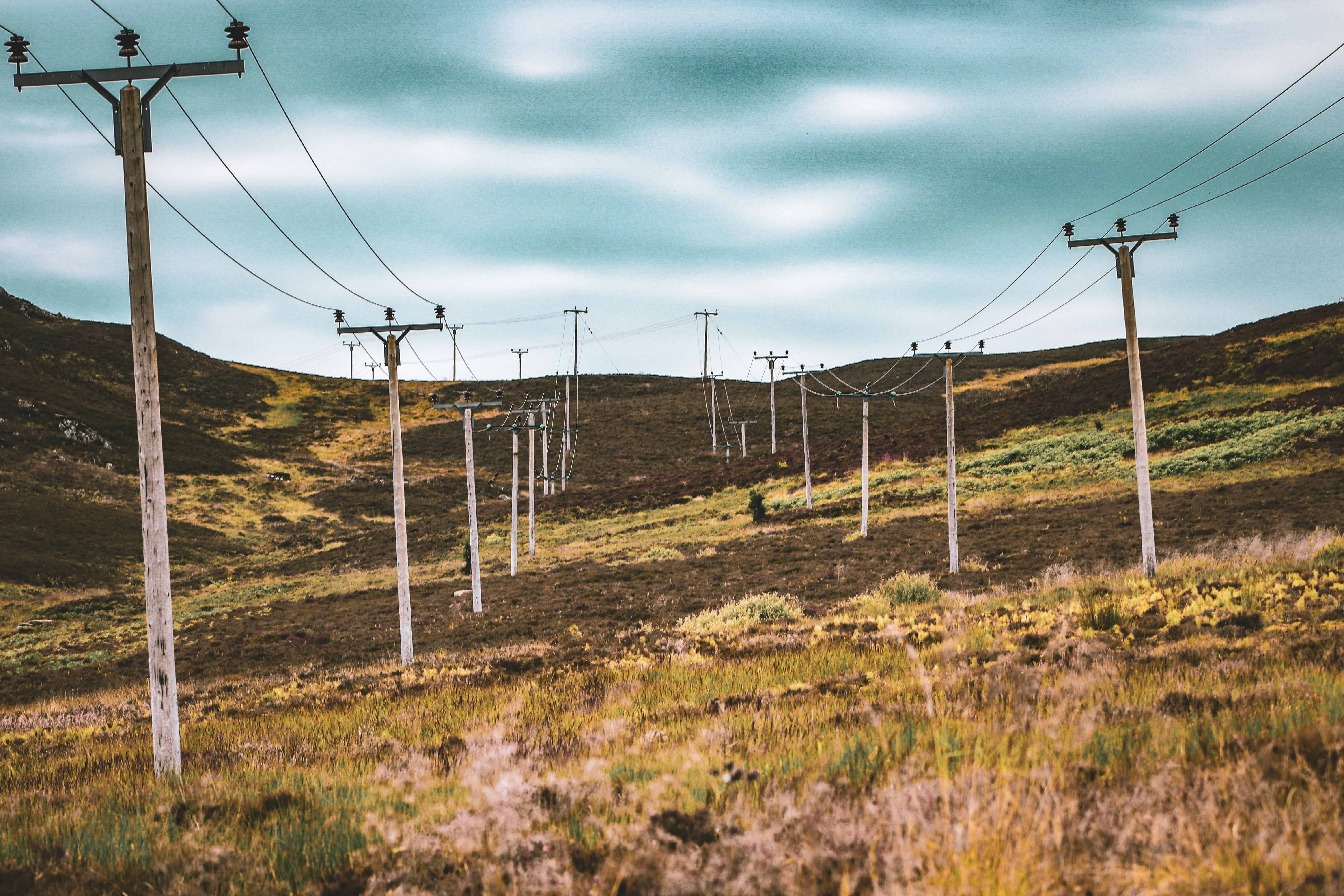
Recent storms have highlighted the vulnerability of overhead electricity networks to severe weather. As we move further into storm season, now is the time to understand the condition of existing timber poles, identify deterioration and consider where assessment, treatment and reinforcement could extend asset life.
Storm Austen brought wind gusts of up to 76 mph to the Isles of Scilly, with similarly strong gusts recorded elsewhere across southern and western Britain. Storm Boelo followed shortly afterwards, bringing further severe weather to Scotland and northern England.
The impact on electricity networks was considerable.
On 25 October, Electricity North West reported more than 250 individual instances of network damage across Cumbria and Lancashire, as high winds brought tree branches and other debris into overhead lines. Gusts reached 78 mph, and conditions remained too dangerous for engineers to climb poles and carry out repairs while the winds were so strong.
Across Scotland, the Scottish Government reported that more than 100,000 customers had lost their electricity supply during Storm Boelo.
These events highlight the difficulties of maintaining overhead networks during successive periods of severe weather. When one storm follows another, the time available for planned maintenance, inspections and repairs can quickly disappear.
Although no maintenance programme can prevent every storm-related interruption, understanding the condition of existing poles allows network operators to identify potential weaknesses and address deterioration before it becomes an urgent problem.
At EP Marine & Rail, we bring more than 20 years’ experience assessing, treating and reinforcing wood utility poles. In suitable cases, our work has helped extend their service life well beyond what might originally have been anticipated.
Importantly, an ageing pole doesn’t automatically need replacing. A thorough assessment can establish whether treatment or reinforcement could keep it in service for longer, or whether replacement is the appropriate option.
A thorough assessment, from top to butt
A visual inspection can identify pockets of decay, external damage, woodpecker activity and pole-top rot. However, it cannot always reveal how much sound timber remains inside a pole or whether internal decay has compromised its structural strength.
Decay commonly develops around ground level, where moisture and air meet, making this a particularly vulnerable area. However, deterioration isn’t confined to the ground line. Pole-top rot, moisture ingress and other damage can also affect the structure. A proper assessment therefore needs to consider the entire pole, from top to butt.
At EP Marine & Rail, our PASS (Pole Analysis and Structural Security) approach combines several assessment methods to build a detailed picture of each pole’s condition.
We begin with a visual inspection, looking for signs of deterioration, physical damage, moisture ingress, pole-top rot and other potential weaknesses along the length of the pole.
Next, we carry out a hammer test. By striking the timber and listening to its acoustic response, we assess its resonance and identify differences that may indicate internal deterioration. A healthy pole typically produces a different acoustic response from one affected by decay. This initial assessment helps us identify potential areas of concern and informs the more detailed investigation.
Measuring residual strength
We then undertake specialist testing at carefully selected locations, including the critical ground-line zone. Three holes, each 10 mm in diameter and equally spaced around the pole circumference, are drilled at ground line and angled downwards at 45 degrees. This allows us to investigate the critical zone approximately 100 mm below ground level.
A Shell Depth Indicator is then inserted to assess the depth of sound wood and identify internal decay.
We enter the findings, together with relevant information such as line loading, conductor type, span length, angle or line deviation and stay configuration, into a handheld device running specialist software. This calculates the pole’s Residual Strength Value (RSV) and determines its fitness for purpose against the original overhead line design parameters and safety factors.
The result is an engineering assessment based on the pole’s measured condition and the demands placed upon it, rather than age or external appearance alone.
Where testing identifies insufficient residual strength at ground line, structural reinforcement may offer a cost-effective way to extend the service life of a suitable pole by up to 20 years.
Treat decay and extend the working life of suitable poles
Discovering decay doesn’t automatically mean a pole needs replacing. Depending on the extent and location of deterioration, treatment may offer a practical way to protect the remaining sound timber and extend its useful life.
One option is boron paste treatment.
Boron-based wood preservatives help control fungal activity within timber. Applied through appropriate treatment points, the preservative helps prevent further decay and halt its progression under suitable conditions.
Treatment is most appropriate where a pole retains sufficient structural capacity. It cannot restore timber that has already lost significant strength, so an assessment is essential before deciding whether treatment is suitable.
Reinforcement: another option before replacement
Where testing identifies reduced structural capacity, reinforcement may provide another practical solution.
EP Marine & Rail undertakes structural reinforcement of suitable wood poles, helping improve their capacity and extend their working life.
Having assessed and reinforced thousands of wood poles, reinforcement is an efficient way of maintaining network resilience and minimising disruption. We can reinforce around 30 poles a week versus the enormous amount of time and resources it takes to replace just one pole.
Make your maintenance budget work harder
With thousands of poles across a network, knowing which assets need attention and which can safely remain in service is essential to effective maintenance planning.
A structured approach to electricity pole maintenance provides the information needed to make those decisions with greater confidence.
Our assessments help identify:
- Poles with sufficient residual strength to remain in service.
- Deterioration that may benefit from boron paste treatment.
- Poles where structural reinforcement may be appropriate.
- Assets requiring closer monitoring or further investigation.
- Poles that genuinely need replacement.
Our own assessment data demonstrates just how many poles can potentially be returned to service. In our testing, up to 60% of S poles and 30% of D poles previously considered unsuitable for continued service were reclassified as serviceable following assessment.
Extending the service life of suitable poles can also help avoid unnecessary replacement costs and reduce the risk of avoidable network interruptions, supporting efforts to manage CIs and CMLs.
Our minimally disruptive approach allows clients to investigate existing assets without removing poles for assessment. We provide clear findings and practical recommendations that maintenance teams can use to plan and prioritise their work.
Prepare your network before the next storm
Storms Austen and Boelo have provided a timely reminder of the pressures severe weather can place on overhead electricity networks. While no assessment or maintenance programme can eliminate every storm-related fault, understanding the condition of existing poles gives network operators the opportunity to address known weaknesses before the next period of severe weather.
EP Marine & Rail combines targeted ground-line investigation, shell depth indicator measurements and specialist software analysis to provide a quantifiable assessment of residual strength. By considering the pole’s condition alongside its original design parameters and the loads it carries, we help establish whether it remains fit for service and what action, if any, is needed.
With more than two decades of practical experience, we bring together engineering assessment and field-based knowledge to help DNOs manage wood utility poles safely, make informed maintenance decisions and get more from suitable existing infrastructure.
If you have sections of your network where wood pole condition is uncertain, or you’re looking for cost-effective ways to manage existing timber infrastructure, we’d be happy to discuss your requirements.
The next storm won’t wait for your maintenance programme. Make sure you know which poles need attention before it arrives.
Contact EP Marine & Rail to discuss how we can support your electricity pole maintenance programme.