
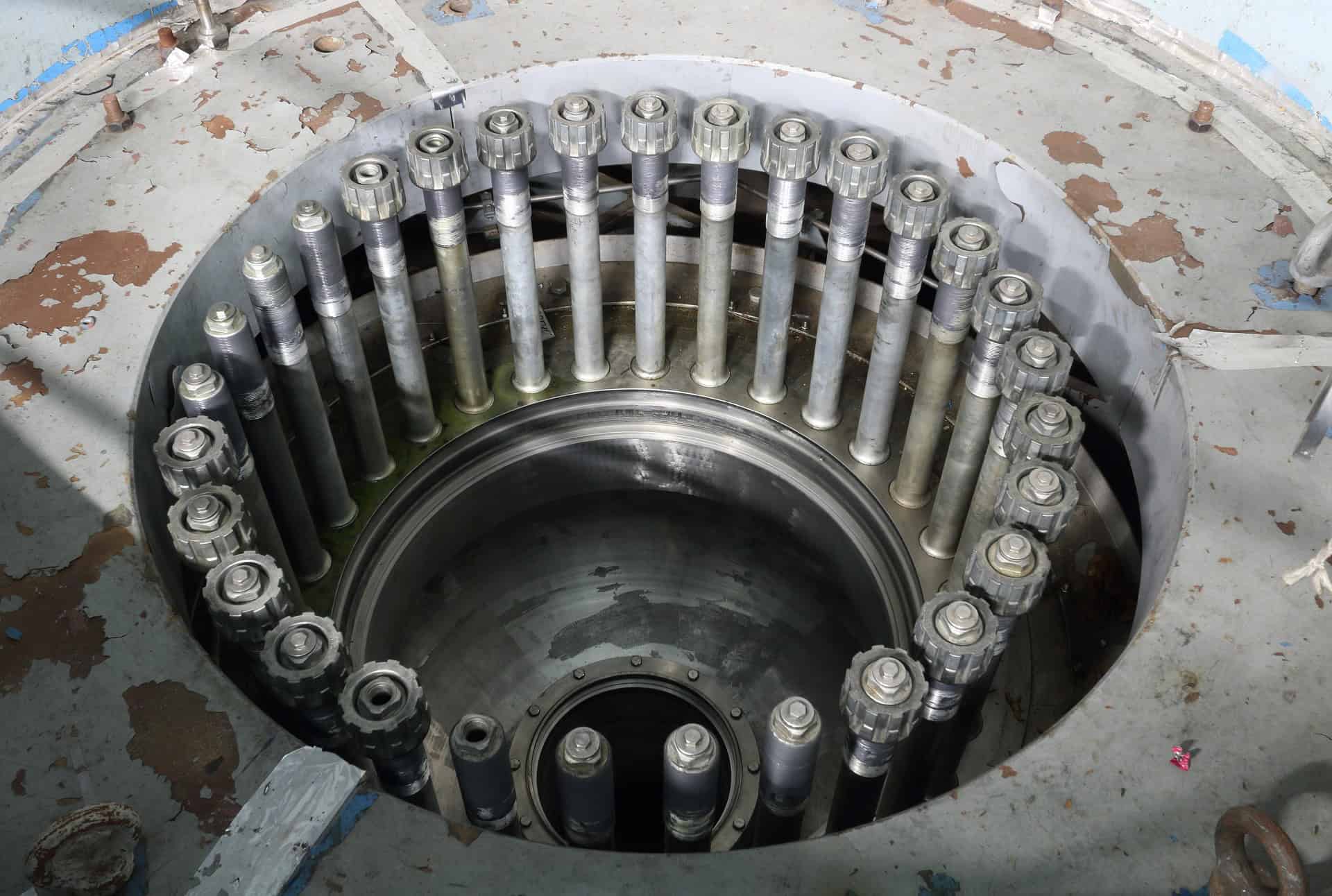
The defects we often find when we’re out assessing marine infrastructure are nearly always hidden from sight.
During testing we reveal many which sit just beneath protective coatings or around stressed fixings and a surprising amount much deeper within the structural systems that hold a marine bollard in place. Just because we can’t see them during a routine visual inspection doesn’t mean they’re not already affecting the integrity of the structure.
That principle is not new. In fact, many of the non-destructive testing methods now used in modern port and harbour infrastructure trace their origins back to high-risk engineering environments such as the nuclear sector, where understanding what was happening beneath the surface became critically important.
Generally, in marine environments, structural issues rarely start with anything visible. More often, they develop within the hidden load path of the structure – particularly around the anchorage system, base plate interface, and surrounding steel that has been carrying cyclic loads for decades. Yet by the time deterioration becomes visible at the surface, the underlying problem has often been progressing for some time.
This is why marine bollard inspection has become so critical in modern port and harbour management. Many bollards in service today were installed long before today’s vessel sizes and mooring forces were ever considered, meaning the original design assumptions are often no longer aligned with current operational reality.
To understand what is really happening in these structures, we need to look beyond surface condition. That’s where non-destructive testing methods such as eddy current testing, ultrasonic inspection, and subsurface assessment come into play, revealing what visual inspection alone will always miss.
Where it began: a problem too critical to “open up”
In the 1950s, engineers working on nuclear reactor systems faced a brutal constraint: they couldn’t dismantle what they needed to inspect.
The components were not only sealed and complex, but also highly hazardous. Conventional inspection methods were simply impossible.
So researchers – including pioneers such as D.L. Waidelich – developed pulsed eddy current techniques (PEC), a specialised branch of eddy current testing designed to inspect conductive materials without physical intrusion, particularly beneath insulation, coatings, and cladding.
What matters here is not just the method itself, but the engineering problem it was solving: how to understand the condition of critical steel systems when you cannot physically access or disrupt them. That same constraint thinking is what later shaped how we inspect infrastructure in other high-risk environments, including ports and harbours.
Conventional eddy current testing (ECT), more commonly used in marine bollard inspection today, operates on the same electromagnetic foundation but is optimised differently. It is used directly on exposed conductive surfaces and is highly sensitive to surface and near-surface defects such as fatigue cracking, corrosion, and stress-related damage in components like bolts, fixings, and base plates.
In other words, PEC is typically used where access is restricted by insulating or protective layers, while ECT is used where the metal surface is accessible, but where visual inspection is no longer sufficient to detect early-stage material degradation.
Both methods share the same physical principles but are optimised for different inspection environments: one for layered, constrained systems, and the other for exposed marine infrastructure where subtle material change is often the earliest warning sign of deterioration.
In marine environments, that sensitivity is invaluable because deterioration rarely starts where we can easily see it.
The chain of errors in practice
And the stakes are not theoretical. In a nuclear system, a microscopic defect left undetected could cascade into system-wide failure.
We don’t need to exaggerate to understand the principle. Systems failures like Chernobyl are often discussed in exactly this context: not as a single point of failure, but as a sequence of small degradations, missed signals, and assumptions that nothing significant was changing.
It’s often a chain of small events that causes the catastrophe. When I was learning to pilot a helicopter, it was rammed into us that accidents are rarely caused by one dramatic failure. More often, they come from a series of small, seemingly insignificant issues that accumulate so quickly that suddenly you are facing a potentially fatal situation.
That same engineering lesson applies just as directly to marine infrastructure, and it is one of the reasons marine bollard inspection plays such an important role in maintaining a safe and functional working environment.
From reactor walls to harbour walls
Eddy current testing (ECT) moved quickly beyond nuclear applications because it solved a universal engineering problem:
How do you understand what metal is doing beneath the surface without disturbing it?
Today, that answer matters in:
- aerospace fatigue monitoring
- heat exchanger and pipeline integrity
- bridge and structural steel assessment
- and critically, marine infrastructure
Because ports are not static environments. They are dynamic load systems which are constantly influenced by:
- vessel size increases
- mooring force variability
- tidal movement
- corrosion cycles
- impact loading
- and decades of incremental stress accumulation
While a bollard may look unchanged, the forces acting through its bolts, base plates, and concrete substrate are anything but constant.
Why “visible condition” is no longer enough
One of the biggest misconceptions in marine asset management is that surface condition reflects structural condition.
Yet, in reality, it rarely does.
Real-world incident investigations repeatedly show that bollard failures are rarely caused by visible deterioration of the bollard itself, but by hidden corrosion and degradation of the anchor bolts and base connections. In several documented cases such as the failure of bolts on a cargo barge bollard; the fatal accident on the River Thames; and the breakaway of VALARIS DS-16, bollards have toppled or failed under load only for post-incident inspection to reveal severely corroded or disconnected securing bolts beneath the surface.
A marine bollard can appear sound while:
- anchor bolts are corroding internally
- fatigue cracks are propagating beneath the surface
- grout pockets have degraded
- or voiding is developing below the base plate
This is where modern marine bollard inspection moves from visual assessment into physics-led diagnostics.
And this is where we separate the tools – and for nerds like us, it gets exciting.
Marine bollard inspection: eddy current vs ultrasonic testing
Although they are often grouped under “NDT”, eddy current and ultrasonic testing do very different jobs when it comes to bollards and their fixings.
Eddy Current Testing (ECT): the surface truth
Eddy current testing works by inducing an electromagnetic field into conductive materials and measuring how that field is disrupted.
In practical marine terms, it is highly effective for:
- detecting surface and near-surface cracking in bolts
- identifying corrosion under coatings
- finding early fatigue initiation zones
- assessing heat-affected or stressed regions around fixings
Think of it as reading the skin-level behaviour of a component.
It is fast, highly sensitive, and extremely effective for early-stage defect detection – especially in exposed steelwork like bollard fixings and base plates.
But it does not “see” deep internal geometry in the same way ultrasound does.
Ultrasonic Testing (UT): the internal map
Ultrasonic testing uses high-frequency sound waves transmitted through material and reflects back changes in density, boundaries, and discontinuities.
In bollard inspection, UT is used to:
- map internal cracking within bolts
- measure remaining section thickness
- identify internal corrosion or inclusions
- assess weld integrity and internal bonding issues
If eddy current is surface intelligence, ultrasonic testing is structural mapping.
It gives you depth, geometry, and internal condition – particularly important where load-bearing components are hidden from view.
Why we combine methods in marine bollard inspection
This is where marine bollard inspection becomes less about visual condition and more about understanding structural behaviour under load. In isolation, each method tells only part of the story, while together, they build a far more complete engineering picture.
At EP Marine & Rail, we combine:
- Eddy Current Testing for surface and near-surface defect detection
- Ultrasonic Testing for internal defect and thickness mapping
- Ground Penetrating Radar (GPR) for subsurface concrete and foundation assessment
This integrated approach allows us to understand not just the bollard, but the system it is anchored into.
What this reveals in real port environments
In practice, the value of combining eddy current, ultrasonic testing, and subsurface GPR assessment is not in the individual findings themselves, but in how they change the level of certainty around decision-making.
Instead of relying on what can be seen at the surface, we can begin to understand how a bollard system is actually behaving under load and how that behaviour is evolving over time.
The engineering principle that hasn’t changed
From nuclear reactor vessels in the 1950s to modern port infrastructure, the principle remains the same:
The most important failures are rarely visible first. They develop insidiously, in places you cannot see, until a threshold is crossed.
Modern inspection technology exists to reduce that blind spot, because in marine environments, time is not neutral. Every tide, load cycle, and vessel movement contributes to the long-term condition of the structure.
What good inspection actually gives you
Done properly, marine bollard inspection – as well as finding defects – gives you time for:
- planning
- prioritising
- replacing before the problem becomes urgent – or dangerous.
And in a live port environment, that’s often the difference between a controlled intervention and an operational problem nobody wanted.
Where this is heading
Marine bollard inspection technology has come a long way since those early nuclear applications, but the principle hasn’t really changed. We’re still trying to answer the same question engineers were asking in the 1950s:
What’s changing, especially where we cannot see it?
At EP Marine & Rail, that’s essentially what our work comes down to: using a combination of eddy current, ultrasonic testing, and subsurface investigation to understand what’s happening inside and below critical marine infrastructure.
Ultimately, marine bollard inspection is about identifying change before it becomes failure.
Closing thought
At EP Marine & Rail, our focus is simple:
See more. Disturb less. Decide earlier.
And the more accurately you can read those early changes, the more control you keep over what happens next.