
Wood pole reinforcement is becoming an increasingly important solution at a time when pressure is rising for UK utilities to operate under supply constraints, rising infrastructure demand, and ongoing economic uncertainty.
The UK timber market is currently in a sensitive position due to political shifts, global tightening of raw material supply, and changing international trade patterns which are influencing producers, distributors, and end users. Some are even forecasting wood pole shortages. At the same time, logistics costs, fuel prices, inflationary pressure, and interest rate uncertainty continue to affect infrastructure delivery timelines and budgets.
For utility operators, this directly affects how they plan asset replacement programmes, manage risk across overhead networks, and control long-term lifecycle costs.
As a result, we are seeing a clear shift in practice: away from default pole replacement and towards targeted wood pole reinforcement.
What we are seeing in the field
In many cases, in the projects we support across the UK, the pole above ground remains structurally sound, while deterioration is concentrated at ground line level. Long-term exposure underpins this decay due to:
- moisture ingress and saturation cycles
- oxygen availability in the splash zone
- fungal decay mechanisms in the ground line transition zone
- repeated wet-dry environmental cycling
- soil chemistry and microbial activity
These conditions create a predictable weak point in otherwise serviceable structures.
In fact, around 90% of timber decay occurs at or near ground line level.
Why timber supply is under increasing pressure
Utility poles require specific timber characteristics, with species such as Douglas Fir and Southern Yellow Pine commonly used due to their strength-to-weight performance.
However, only a limited amount of harvested timber meets utility-grade specs. Even within suitable species, further grading significantly reduces usable output due to natural variability such as knots, grain deviation, and structural imperfections.
This creates an inherently constrained supply chain before even considering external market pressures.
On top of this, global factors are driving increased volatility including:
- longer and less predictable shipping routes
- rising freight and transport costs
- fuel price instability
- geopolitical disruption affecting trade corridors
- consolidation within sawmill and timber processing industries
Although UK supply depends largely on Scandinavian and Northern European imports, global logistics increasingly influence the supply of raw materials.
At the same time, demand continues to rise due to wider infrastructure expansion, grid reinforcement programmes, and ongoing network modernisation.
This imbalance is one of the key reasons wood pole reinforcement is gaining traction as a practical alternative to full replacement where poles remain structurally suitable.
Why this matters commercially
Pole reinforcement systems have been used successfully across Australia and the US for many years. We are now seeing growing adoption across UK networks.
Since 2007 we have reinforced timber poles throughout the country, helping utilities extend asset life while avoiding unnecessary replacement.
And because the existing pole remains in place, we can complete multiple reinforcements each day. In many cases, crews can install up to eight reinforcements in the time it would take to replace a single pole using traditional methods.
The system also supports lifecycle reusability. When a pole eventually reaches end-of-life, teams can often transfer the steel reinforcement system onto the replacement pole. This improves both material efficiency and sustainability outcomes.
These benefits create clear operational and commercial advantages:
- reduced need for full pole replacement
- extended asset life by up to 20 years in suitable conditions
- no requirement for excavation or full reinstatement
- reduced reliance on heavy plant access
- minimal environmental and ground disturbance
- continued access around the pole for maintenance activities
Another major advantage is the ability to complete reinforcement works without planned outages in many cases.
Full pole replacement often requires scheduled shutdowns. These shutdowns increase CIs and CMLs while placing additional pressure on network planning and resource allocation.
By contrast, wood pole reinforcement helps utilities maintain service continuity. It also improves network efficiency and reduces disruption for end users.
How the reinforcement system works in practice
Our multi-tube reinforcement system strengthens decayed S and D poles without the need for full replacement.
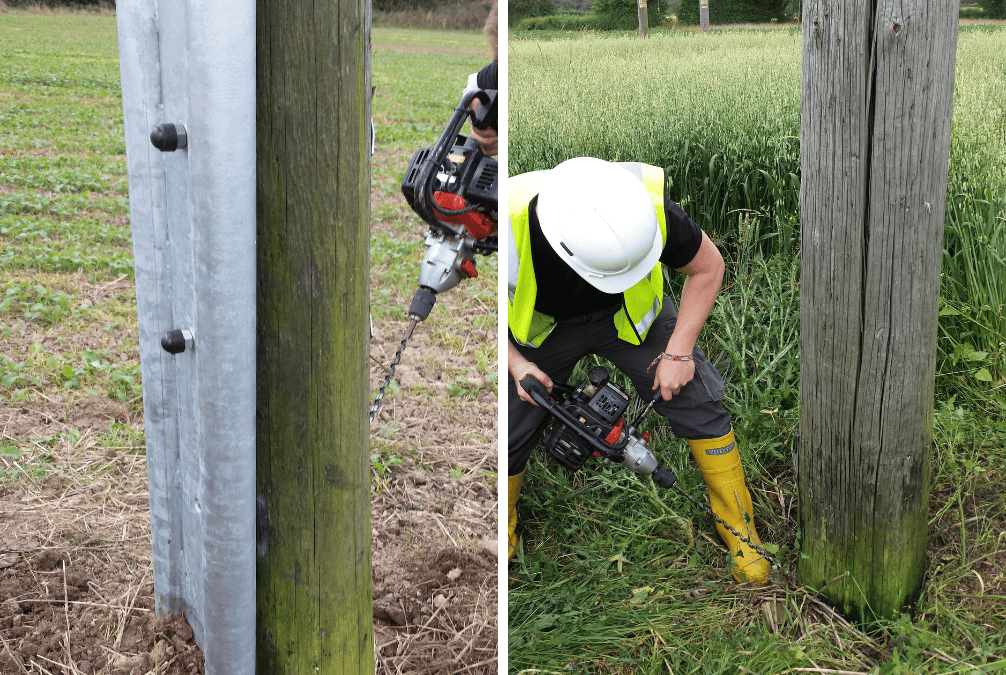
The system uses engineered steel trusses installed on either side of the timber pole. These trusses effectively sandwich the structure at the critical ground line zone, where most deterioration occurs.
This design redistributes loads through the weakened section, compensating for lost strength caused by decay. It also improves resistance to lateral forces, helping the pole withstand operational and environmental loading.
In structural terms, the system can withstand applied forces in excess of half a tonne. This exceeds typical wind loading conditions, including extreme weather events with wind speeds above 100 mph.
By reinforcing the ground line zone, the system extends the useful life of the asset while maintaining the structural integrity required for safe operation.
Sustainability and lifecycle efficiency
We can’t ignore sustainability which has become a key driver in infrastructure decision-making, particularly for utilities under pressure to reduce carbon impact and demonstrate lifecycle efficiency.
Timber remains one of the most sustainable structural materials available when sourced from managed forestry systems. It is renewable and stores carbon within the structure itself. What’s more is it requires significantly less energy to process than steel, concrete, and many engineered, composite alternatives.
However, sustainability is not only about material selection. It is also about how efficiently existing assets are used.
Replacing structurally recoverable poles prematurely leads to unnecessary:
- material consumption
- transport emissions
- manufacturing demand
- waste generation
By extending the life of existing infrastructure, wood pole reinforcement improves resource efficiency and reduces environmental impact across the asset lifecycle.
The wider economic and operational context
Infrastructure decisions cannot be separated from wider economic conditions.
Based on what we are seeing in the field, wood pole reinforcement is becoming a core part of modern overhead line asset management.
Utilities are increasingly adopting hybrid approaches that combine:
- targeted reinforcement where structurally appropriate
- full replacement only where necessary
- preventative protection for newer assets
- lifecycle-based planning rather than reactive intervention
In this context, wood pole reinforcement is becoming a standard tool in maintaining resilient, cost-effective overhead networks.
Conclusion
The pressure on timber supply chains, rising infrastructure demand, and increasing operational constraints are converging on a single point: utilities need more efficient ways to manage existing assets.
By focusing on the structural reality of timber poles – where failure occurs and how strength can be restored – wood pole reinforcement provides a practical, field-proven method of extending asset life without unnecessary replacement.
In many cases, this approach delivers cost savings, operational efficiency, improved sustainability, and reduced network disruption.
As infrastructure demand continues to grow, this combination is becoming increasingly important – and increasingly standard in modern utility asset management.