
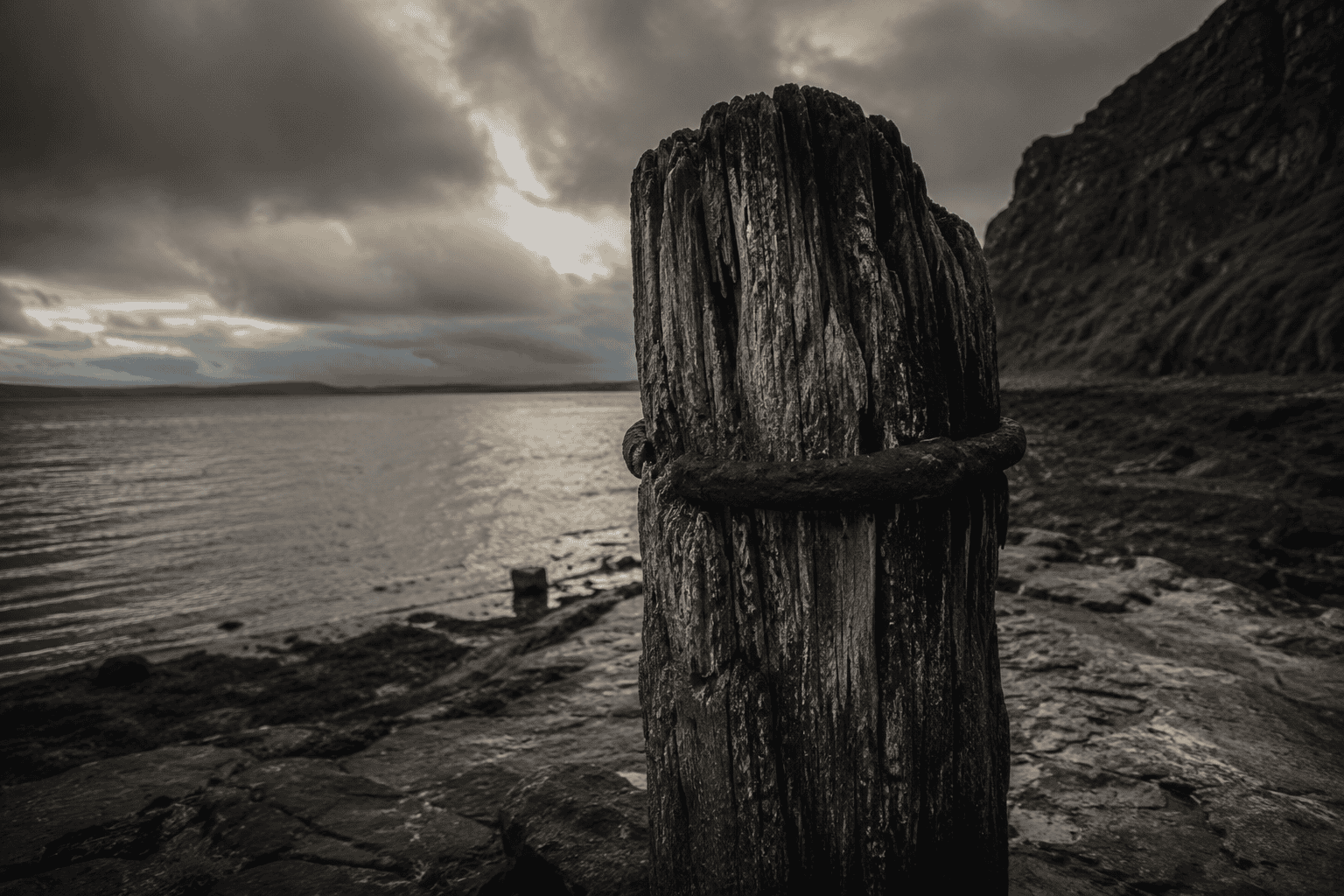
Imagine standing beside a harbour two centuries ago. The wind cuts across the water. Salt spray clings to everything it touches. Heavy ropes strain against enormous oak posts or weathered granite mooring stones as sailing ships settle alongside the harbour wall.
These early commercial marine bollards did not look like the engineered structures we recognise today. They were shaped as much by geography as by engineering.
In many harbours, they were enormous oak posts, selected for their strength and resilience and shaped by skilled craftsmen. In others, particularly where hard stone was abundant, they were carved from granite and built directly into the fabric of the quay itself.
Both materials reflected the resources available to the communities that built them. Before industrial manufacturing transformed construction, transporting heavy materials over long distances was difficult and expensive. Harbour builders worked with what their landscape provided.
Their surfaces carried the evidence of a working life. Storms battered them. Waves soaked them. Generations of sailors wrapped ropes around them as ships arrived from distant shores and departed again with new cargo, new passengers and new stories.
Those oak posts and granite mooring stones formed one of the most important connections in any harbour:
The connection between ship and shore
At the time, they represented the best engineering solution available. They matched the vessels, the materials and the maritime demands of their era.
They endured because oak was one of the most resilient timbers available to harbour builders. Its dense grain, natural strength and resistance to wear made it capable of withstanding the repeated stresses of mooring operations and decades of exposure to a harsh marine environment. However, like all timber structures, the greatest threats came from prolonged exposure to moisture, oxygen and biological activity, particularly around areas where water could collect and where repeated wetting and drying accelerated deterioration. Granite, meanwhile, offered exceptional durability, with many historic examples still standing today as reminders of the working harbours that created them.
From oak and granite to iron and industry
Over time, the graceful wooden ships that once relied on wind and tide gave way to a new industrial reality. The sounds of canvas and rigging were replaced by the noise of steam engines, machinery and expanding industrial activity. Cargo volumes increased. Industrial centres grew. Ports became the beating heart of global commerce.
Consequently, the forces acting upon harbour infrastructure changed dramatically.
Large timber posts and granite bollards had served generations of sailing vessels well, but the arrival of steamships and larger cargo vessels introduced new challenges. Ships became heavier. Berths became busier. Mooring loads increased.
The materials that had served the age of sail were no longer always sufficient for the demands of industrial shipping.
And thus, iron began to transform harbour infrastructure.
Cast iron became one of the next major steps in the evolution of the commercial marine bollard. Unlike timber and stone, it could be manufactured in foundries to consistent shapes and sizes, allowing ports to install stronger and more uniform mooring points capable of handling the growing demands of industrial vessels.
It represented a shift from locally sourced materials shaped by individual craftsmen to engineered components produced for increasingly complex maritime environments.
However, cast iron also had limitations. While it offered excellent compressive strength, it could be relatively brittle when subjected to sudden impact or shock loading. As vessels continued to increase in size throughout the twentieth century, engineers developed improved materials, including cast steel and later ductile iron, which offered greater strength, toughness and resistance to the repeated forces generated by modern commercial shipping.
The harbours that carried generations
Not every harbour became a vast industrial port.
Some remained fishing harbours. Others became naval bases. Some transformed into major commercial centres.
Walk along Britain’s historic quaysides and you can see layers of maritime history built into the landscape:
Granite walls. Stone piers. Weathered mooring points. Structures that have witnessed generations of vessels arriving, departing and changing with the times.
The materials changed because the world changed.
Yet the purpose remained the same: creating a safe and reliable connection between vessel and shore.
The evolution of historic harbours
Take Penzance Harbour.
Its granite-built harbour which has served the area since the 14th century, reflects the importance of local materials, traditional craftsmanship and practical engineering. For generations, the harbour has provided an important connection between mainland Cornwall and the Isles of Scilly, supporting passenger services, freight movements and the communities that depend on this maritime link.
The arrival of new generations of vessels demonstrates the same principle that has shaped ports for centuries: infrastructure must continue to evolve if maritime connections are to endure.
Further east, Bristol Harbour provides another remarkable example of engineering adaptation.
One of Britain’s great historic ports, Bristol grew from a medieval trading harbour into a centre of exploration, commerce and engineering innovation. As shipping expanded, however, the tidal River Avon became an increasing challenge.
Engineers responded by creating William Jessop’s Floating Harbour, completed in 1809, allowing ships to remain afloat rather than being restricted by the Avon’s extreme tidal range. It was a bold solution to a changing maritime challenge – one that helped cement Bristol’s reputation as a centre of maritime engineering and innovation.
Meanwhile, Port of Mostyn demonstrates perhaps one of the clearest examples of a port adapting across multiple generations. With a history stretching back centuries, Mostyn has supported changing industries, from traditional cargo operations through to modern renewable energy developments.
Its story reflects a wider truth about ports:
The strongest infrastructure is not always the newest.
It is infrastructure that continues to adapt.
Steel, steam and the rise of modern ports
As a result, commercial marine bollards became a reflection of a much larger transformation taking place across global shipping.
And during the twentieth century, ports evolved at remarkable speed.
Containerisation changed the way goods moved around the world. Bulk carriers grew larger. Cruise ships expanded beyond anything earlier generations could have imagined. Offshore industries introduced new vessel types and new operational demands.
The humble mooring point became a highly engineered asset.
Modern commercial marine bollards are designed to withstand significant loads, but their performance depends on much more than the material from which they are manufactured.
Consequently, engineers need to consider:
- bollard design and capacity
- fixing arrangements
- foundation integrity
- quay structure condition
- environmental exposure
- changing operational requirements
Furthermore, many commercial marine bollards currently in service were installed decades ago, when the vessels using those berths looked very different.
Ship types and operating conditions of their time influenced the design of mooring bollards across the ages.
Today, however, ports and harbours must understand whether those same assets remain suitable for the demands placed upon them.
Today’s challenge: supporting larger ships and changing industries
Although materials have changed dramatically, one principle remains the same:
Infrastructure must continue to match operational demands.
Today’s ports operate in an environment that previous generations could never have imagined. Still, to this day, when I look upon one of the latest cruise ships, they astound me with just how enormous they are.
And this means that larger cruise vessels bring increased passenger capacity and very different mooring considerations.
Offshore energy developments require ports capable of supporting specialist vessels and complex operations.
Meanwhile, increasingly severe weather events create additional challenges for infrastructure that may already have decades of service behind it.
For Harbour Masters, Engineering Directors and marine operations teams, the question is rarely simply:
“How old is this bollard?”
The more important question is:
“What condition is this asset actually in today?”
Age alone does not determine whether a commercial marine bollard remains suitable for service. Understanding the condition of the complete mooring system allows informed decisions to be made.
The ports of tomorrow: energy transition and new opportunities
Today, another transformation is underway.
This time, however, the driving force is not steam, coal or industrial expansion.
It is the transition towards cleaner energy.
Ports that have supported generations of maritime activity are now preparing to support the next chapter of the energy story.
Milford Haven provides a powerful example of this evolution. For centuries, its deep natural harbour has shaped the identity and prosperity of the surrounding communities, providing a gateway for trade, industry and maritime activity. Its history is closely intertwined with the people who live and work around the water, creating a legacy built on resilience, adaptation and connection.
Today, Milford Haven is once again evolving – building on its established role as a major energy hub while embracing the opportunities created by the transition towards renewable energy. Its ambitions in areas such as floating offshore wind, clean energy infrastructure and future fuels demonstrate how our valued, historic maritime assets can become foundations for the industries of tomorrow.
Likewise, Aberdeen tells a similar story. Established in 1136 and recognised as the UK’s oldest existing business, the port has continually adapted from medieval trade and fishing to becoming a global hub for offshore energy. Today, its landmark South Harbour expansion is positioning Aberdeen to support the next generation of offshore wind, maritime logistics and clean energy projects.
These ports demonstrate something that has been true throughout maritime history:
They treasure their heritage, respect the communities they serve, invest wisely and adapt for the future.
Understanding existing infrastructure before investing in the future
Therefore, as ports prepare for the next generation of maritime activity, understanding the condition of existing assets has never been more important.
Replacing every ageing asset is not always practical, necessary or sustainable.
Equally, assuming that an older asset remains suitable simply because it has performed well for decades carries its own risks.
The answer lies in understanding what is happening beneath the surface.
Modern, non-destructive testing techniques allow us to assess both historic and commercial marine bollards, fixings and surrounding structures without the disruption and risk associated with destructive testing methods.
By identifying hidden issues such as corrosion, voids, cracking or deterioration, ports can make evidence-based decisions about maintenance, repair, safe working loads and future investment.
This approach allows operators to protect valuable infrastructure while planning confidently for the future.
From timber and stone mooring posts to the ports of tomorrow
Every commercial marine bollard tells a story.
Some tell stories of sailing ships, oak timbers, granite mooring stones and generations of seafarers.
Others reflect the industrial ambition that transformed global trade.
Many today represent the next chapter of maritime evolution – supporting cruise vessels, commercial shipping, offshore industries and the transition towards cleaner energy.
The materials have changed.
The ships have changed.
The demands placed upon ports and harbours have changed.
However, one responsibility remains constant.
The people who manage our ports and harbours are custodians of infrastructure that connects generations.
The goal is not simply to replace what came before.
It is to understand it, protect it and ensure it continues to serve the vessels and communities of tomorrow.
Because the ports of the future will not only be built with new infrastructure.
They will also be shaped by how wisely we care for the heritage and infrastructure we already have.